Sunday, December 7, 2008

NCOS December meeting

This afternoon was our December NCOS meeting, with a holiday party. The attendance was strong, and the show tables were filled--the Paphs. having the strongest representation.

(Cyc. pentadactylon 'Jumbo Best' x Morm. sinuata 'Fireball'), exhibited by Chryss Mavrides.


Brachypetalum hybrids. All have Paph. concolor in their parentage. Display by Susan Kulhavi.


Paph. Angel Hair, exhibited by Barry Woolf.


Paph. parishii, exhibited by Barry Woolf.


Top to bottom: Paph. Green Cascade 'Penns Creek' HCC/AOS; Paph. Pukekaikiore 'JAN'; Paph. Icy Icy Wind 'Cattaraugus Creek'; exhibited by Bill and Lynn Goldner.


Paph. Mishima Elf; first bloom seedlings/siblings exhibited by Roddy Gabel.


Blc. Chia Lin 'New City' AM/AOS, exhibited by Ken Meier.


We won't meet again for another six weeks (Sunday, January 18, 2009).

Saturday, December 6, 2008

AOS Judging, December 6, 2008

Below are pics from today's AOS judging at the National Arboretum. The AOS judges gave an introductory lecture to members of the Maryland Orchid Society about the judging process, the standards by which orchids are judged, an example of improving flower quality over time using white phaelenopsis breeding as a model, and then some quizz slides to (successfully!) provoke discussion between the judges, and between the judges and the audience.

The number of plants put up for judging was greater than usual. But, it was an active, enjoyable and educational day.

Paph. Green Cascade 'Penns Creek' (Paph. Elfstone x Paph. Stefani Pita); HCC/AOS, 79pts


Zelenkocidium Thunderhead (Zelenkocidium Aloha x Clown Ears); HCC/AOS, 79pts


Paphinia Majestic (Paphinia cristata x Paphinia herrerae), four flowers on one inflorescence; AM/AOS, 87pts


Dendrobium Stephen Batchelor (Den. alexandrae x Den. johnsoniae); CCM/AOS, 81 pts


(Cyc. chlorochilon x Cyd. Jumbo Micky); screened but some flowers on both inflorescences were damaged and/or just past prime, thereby preventing a nomination. The disappointed judges discussed several means by which the exhibitor should package the flowers to prevent damage during transport. Perhaps next year...


Scaphosepalum decorum; CCM/AOS 81 pts


Clowesetum Dragon's Treasure (Cl. warscewiczii x Clo. Pink Lemonade) 'Miss Anita'; AM/AOS 84 pts


After most of my clerking duties were complete, I was able to participate in drafting the description for Dragon's Treasure.

Friday, December 5, 2008

Cymbidium mastersii

Cymbidium mastersii is also in bloom. This was a surprise for me because I didn't expect the plant to flower for another year. It was recently purchased from a California vendor so I thought it would need another season to adjust to this region. The plant was tucked into a location under the backyard shade frame, and I didn't notice that the plant was in spike. Only when I brought the Cyms indoors for Winter did I noticed that the buds had already cleared their sheath.
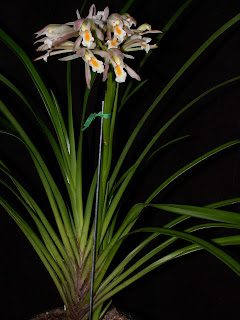


According to "The Genus Cymbidium" by DuPuy and Cribb (2007), Cym. mastersii flowers do not fully open, shape and coloration is variable; petals and sepals range in colors from white to faintly pink; lip is white with a yellow central patch and yellow callus ridges, with some varieties showing pale to strong purple-red spots one the side- and mid-lobes; column white or pale green (see pages 212-216; figures 120-123). It flowers between October and December.

Here's a link to another description of the species: http://marniturkel.com/Pages/orchids/o.articles/cym.mastersii.html. There's plenty of information out on the web, including pics of white (or alba) forms of the species.

Previous AOS awards for Cym. mastersii:
1. 'Cinnabar', CBR/AOS; 14 flowers on 2 inflorescences; February 7, 1995.
2. 'La Gobielle', CHM/AOS 83 pts; 49 flowers and 45 buds on 18 inflorescences; November 10, 2001.


Stats of my plant in AOS format (for my practice)
Natural spread: 4cm horizontal, 3.5cm vertical
Dorsal sepal: 5cm length, 0.8cm width
Petal: 4cm length, 0.4cm width
Lateral sepal: 5cm length, 0.7cm width
Lip: 4cm length, 1.1cm width
Description: 10 flowers on one inflorescence; petals and sepals white with rose-pink on outer surface; lip white, yellow throat and yellow-orange callus; substance light; texture matte.
The flowers seem most fragrant around mid-day-perhaps after having been warmed by the morning sun? I can't say it's "almond scented" as commonly described; rather, there's a slight fruity quality to the fragrance, at least to my nose.

Cymbidium Eastern Bunny 'Oborozuki'

As discussed in an earlier post, Cym. Eastern Bunny 'Oborozuki' is entering its blooming season--the second time this year!

Cym. Eastern Bunny=(Cym. goeringii x Cym. Lovely Bunny).
'Oborozuki' appears to be a Spring term meaning "hazy moon" , see http://renku.home.att.net/500ESWd.html.

The flowers pictured below come from a plant with four pseudobulbs, the largest and youngest bulb responsible for four inflorescences and the second largest bulb responsible for another inflorescence, each spike (five total) at different stages of maturation. The plant is in a 5" pot, about 1.5' tall and about 2' canopy diameter. A second plant (not shown) has nine inflorescences, also at different stages of maturation, and about the same growth habit. Both plants reside side-by-side in an East/Southeast-facing garden window, having been placed there upon receipt from George Hatfield's visit this last May.


Stats in AOS format (for my practice)
Natural spread: 6.5cm horizontal, 5cm vertical
Dorsal sepal: 4.5cm length, 1.8cm width
Petal: 4cm length, 1.4cm width
Lateral sepal: 4.5cm length, 1.8cm width
Lip: 3cm length, 2cm width.
Description: 6 flowers on a first inflorescence. 4 flowers on a second inflorescence. Sepals and petals even pale yellow on top of faint green base; lip faint pale yellow on top of white base; column light green at apex becoming pale yellow towards base with inner surface strongly striped in dark red; substance heavy; texture waxy.

Still going strong as of January 23, 2009, with other inflorescences now in bloom.

Saturday, November 22, 2008

Lowering the Lights

This weekend's project was to lower the lights from the lightmover/ceiling to increase the lux/fc value at the orchid canopy. As you can see in the first picture, the lights are pretty close to the ceiling, and actually higher than they were placed last year.


I installed some chains that allow me to vary the distance each light may hang from its lightmover. The lower the lights hang, less area is illuminated, so I'm trying to find a compromise setting for this season. The maximum length will place the lights directly on top of the Cym canopy. While this achieves over 10,000 lux, the area illuminated is quite small.


At the above length, the lights are about 18 inches closer to the canopy than they were last year. (The calculation/measurement also includes the distance due to raising the plants off the floor with the palettes--another feature I did not have last year.) According to the light meter, the maximum lux per light at canopy level is now about 7,500 lux. Because this is an improvement over last year, I expect that the orchids will be fine. However, with light meter in hand, I must admit that I'm already thinking of improved lighting designs for next year, e.g. putting two lights onto each lightmover (four lights total).

Note: Although the photos indicate that the lights move synchronously, they are, in fact, asynchronous. The light on the left is set to pause at each end of the rail for about 17 seconds. The light on the right is set to pause for about 19 seconds. The lights take about 90 seconds to traverse the rail length.

Monday, November 17, 2008

November NCOS meeting

NCOS held it's monthly meeting yesterday. The guest speaker was Ernie Gemienhart of EnLightened Orchids (AOS Orchids, December issue, pgs 906-909, 2007) who discussed methods of growing orchids under lights indoors, e.g. spare bedroom, basement or garage. This was a timely topic given that I brought my Cyms indoors into my basement space just a few days earlier. Ernie has some nice ideas that I'll keep in mind as I evaluate the working conditions and overall plant health.

Below are some pics from the member's show table.
Lc. Gaskell Pumila 'Azure Star' HCC/AOS


Cyc. Wine's Delight 'J.E.M.'


Cirr. Elizabeth Ann


C. Portia 'Cannizaro' AM/AOS

Friday, November 14, 2008

In for the Winter

I moved my Cymbidiums into the basement tonight for their Winter season. We've had some light rain and/or overcast skies for several days now, with more light rain forecasted for the weekend. After that, the forecast is for below 30F nighttime lows, which combined with the saturated media would not be good for the Cyms.

Over half of the Cyms are in spike, and I am hopeful that the remaining will generate inflorescences in another month or so. I have a number of seedling crosses that are expected (should be mature enough) to bloom this year. Cym. mastersii, Cym. Eastern Bunny 'Oborozuki', and Cym. (lowio-mastersii x Summer Sands) have buds that have just cleared their sheaths. I'll be posting photos as the flowers open up.

I had noticed that some of my Cym. devonianum and devonianum hybrids were potted too low beneath the pot's edge, which will prevent the inflorescences from clearing the pot. So, I raised those plants "needing a lift" out of their pots such that the base of the pseudobulbs is now a half inch or so above the pot's edge. I had seen this "lifting" practiced while visiting Top Hat Orchids in Richmond, CA this last Spring. It was a good thing for me to do because, while doing so, I noticed that both Cym. Langlyense 'Cascades' and Cym. Miss Muffet 'Julie Sato' were developing multiple spikes beneath the media. These plants were on my potential discard list because they haven't flowered for me for a couple of years. But now, I have an explanation why I wasn't seeing any flowers, and I'm hopeful that the little spikes I saw will fully mature.