Sunday, February 13, 2011

Riverbanks Orchid Festival, S.C.

It's Show season, which means there is an orchid show almost every two weeks from now through the end of March. The exhibits shown below are from the Riverbanks Orchid Festival held this past weekend in Columbia, South Carolina in the Botanical Garden Visitor Center within the Riverbanks Zoo and Botanical Garden. I had a fun time socializing with the society member clerks and AOS judges during ribbon and flower quality review. The host orchid society (South Carolina O.S.) had a large, walk-thru exhibit that was too large to be captured in a single pic.

Coastal Carolina O.S. exhibit, Charleston, S.C.


Carter & Holmes exhibit, Newberry, S.C.


Aiken-Augusta O.S. exhibit, Augusta, GA


Triad O.S. exhibit, Greensboro, N.C.


North Carolina Piedmont O.S. exhibit, Charlotte, N.C.


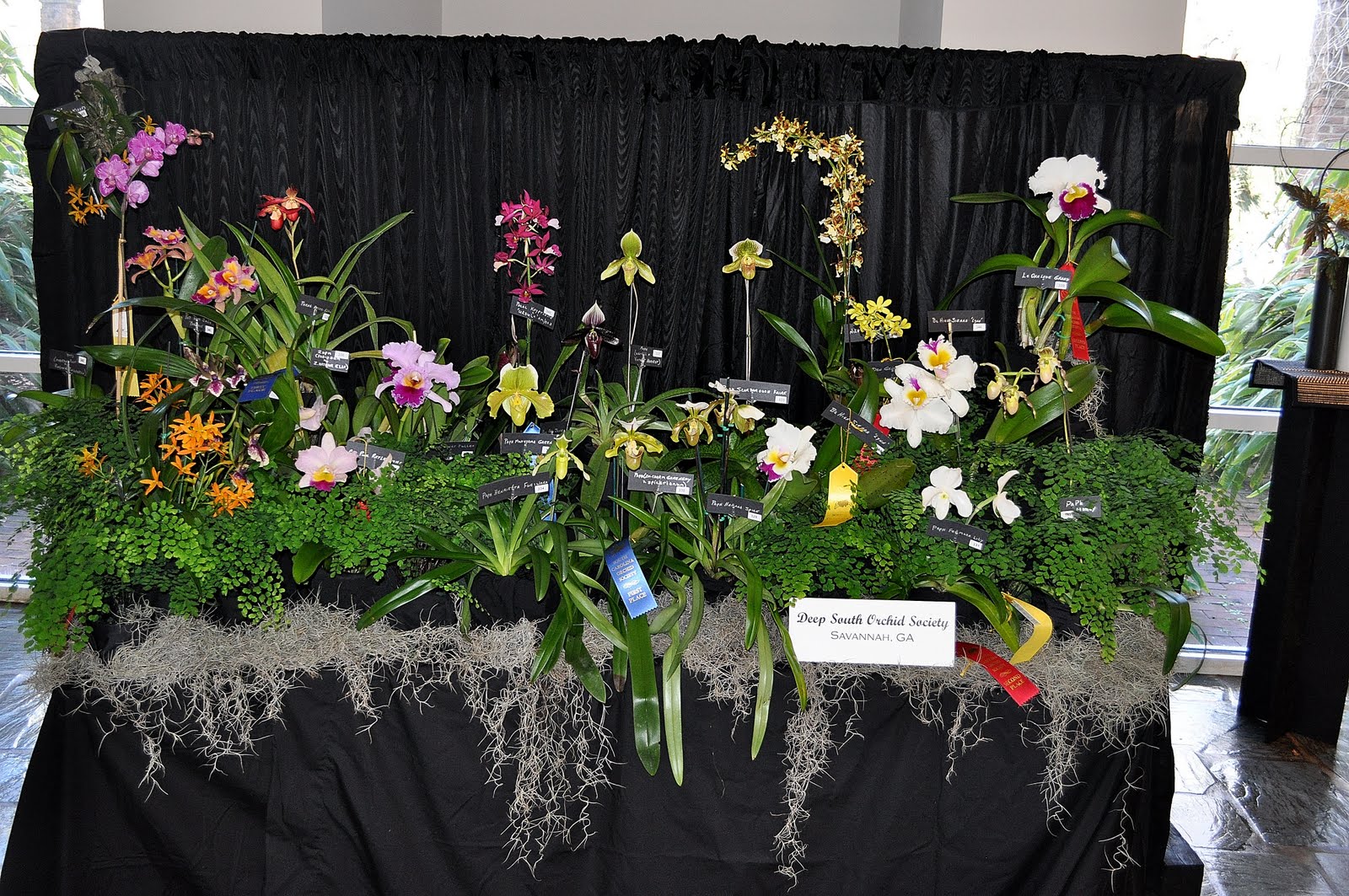
Deep South O.S. exhibit, Savannah, GA. This exhibit suffered from being in the light shadow cast by the large windows on both sides. Consequently, all the flowers were under-illuminated and difficult to see. The exhibit would have scored higher if they provided lights to compensate.


Cymbidium Ruby Shower 'Murasaki-okimi', exhibited by South Carolina O.S.
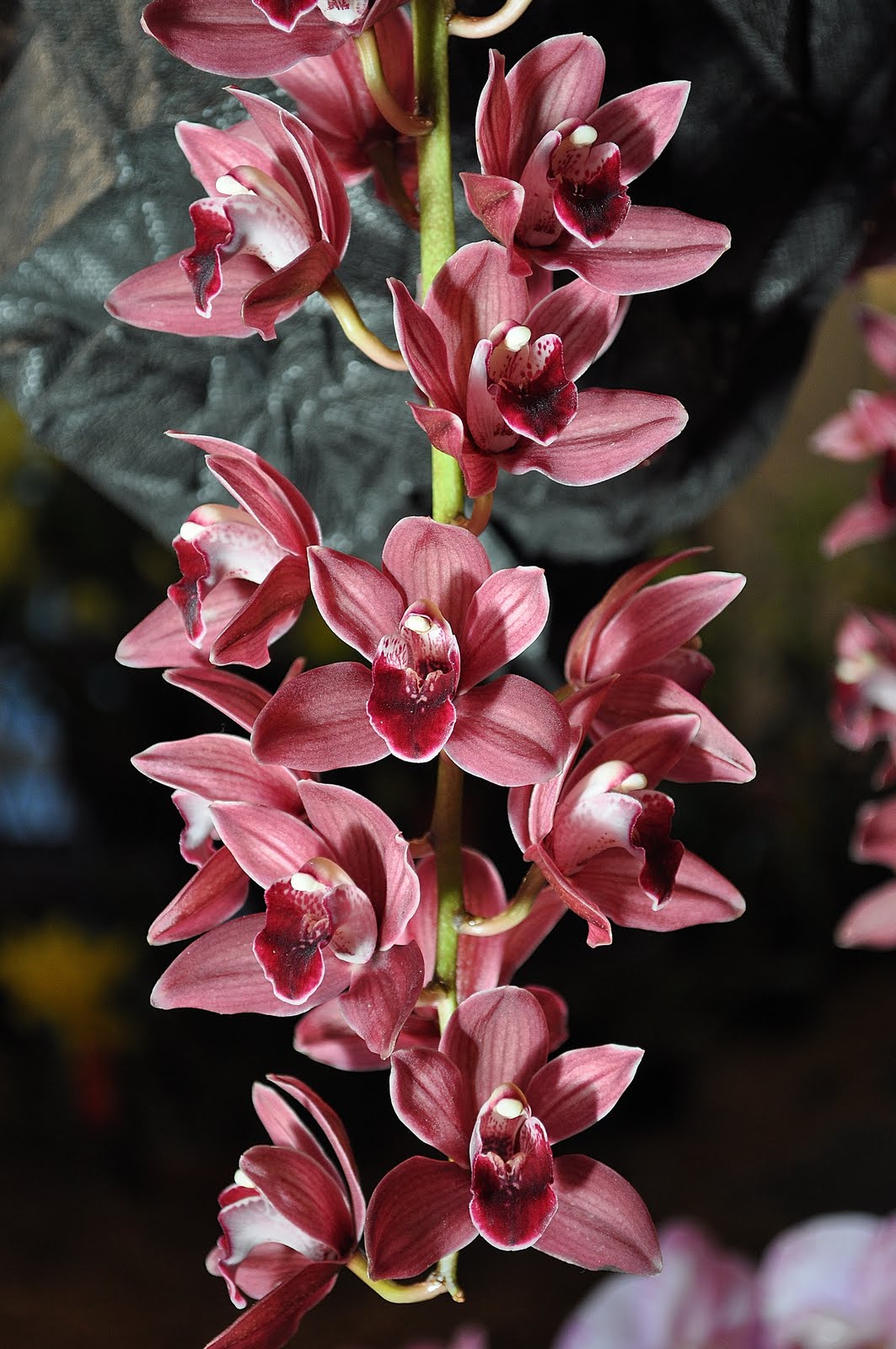


Cymbidium Morning Shower 'Tiny Jewel ', exhibited by South Carolina O.S.


Cymbidium Lovely Bunny, exhibited by Aiken-Augusta O.S.


Cymbidium Jill 'Betty Jo', AM/AOS, exhibited by Carter & Holmes


Lycaste Helen Congleton, exhibited by South Carolina O.S.


Lycaste Aquila 'Detente', AM/AOS, exhibited by South Carolina O.S.


Bulbophyllum eberhardtii, exhibited by South Carolina O.S.


Dendrobium speciosum var. pendunculatum 'Riverwood', AM/AOS, exhibited by South Carolina O.S.


Dendrobium speciosum var. grandiflorum 'San Bar Yellow King', exhibited by South Carolina O.S.


Dendrobium Warragul 'Jet Stream', exhibited by South Carolina O.S.


Stenorrhyncus speciosus, exhibited by Triad O.S., awarded a CCM/AOS


Blc. Traveling Star 'Polar Glow', exhibited by South Carolina O.S.


Cattleya trianne 'Arenka Germanske', FCC/AOS, exhibited by Triad O.S.


Slc. Jeanne Wilson 'MVO', AM/AOS, exhibited by Carter & Holmes


Phaius tankervilliae var. alba, exhibited by Coastal Carolina O.S.


Phragmipedium (Sorcerer's Apprentice, 4N x caudatum var. sanderae), exhibited by Western North Carolina O.S.


Paphiopedilum Raisin Jack, exhibited by Carter & Holmes


Paphiopedilum appletonianum, exhibited by Carter & Holmes


Paphiopedilum Rory Jones, exhibited by Deep South O.S., Savannah, Georgia


Paphiopedilum Formosa Lily, exhibited by Deep South O.S., Savannah, Georgia


Paphiopedilum Honey, exhibited by Deep South O.S., Savannah, Georgia
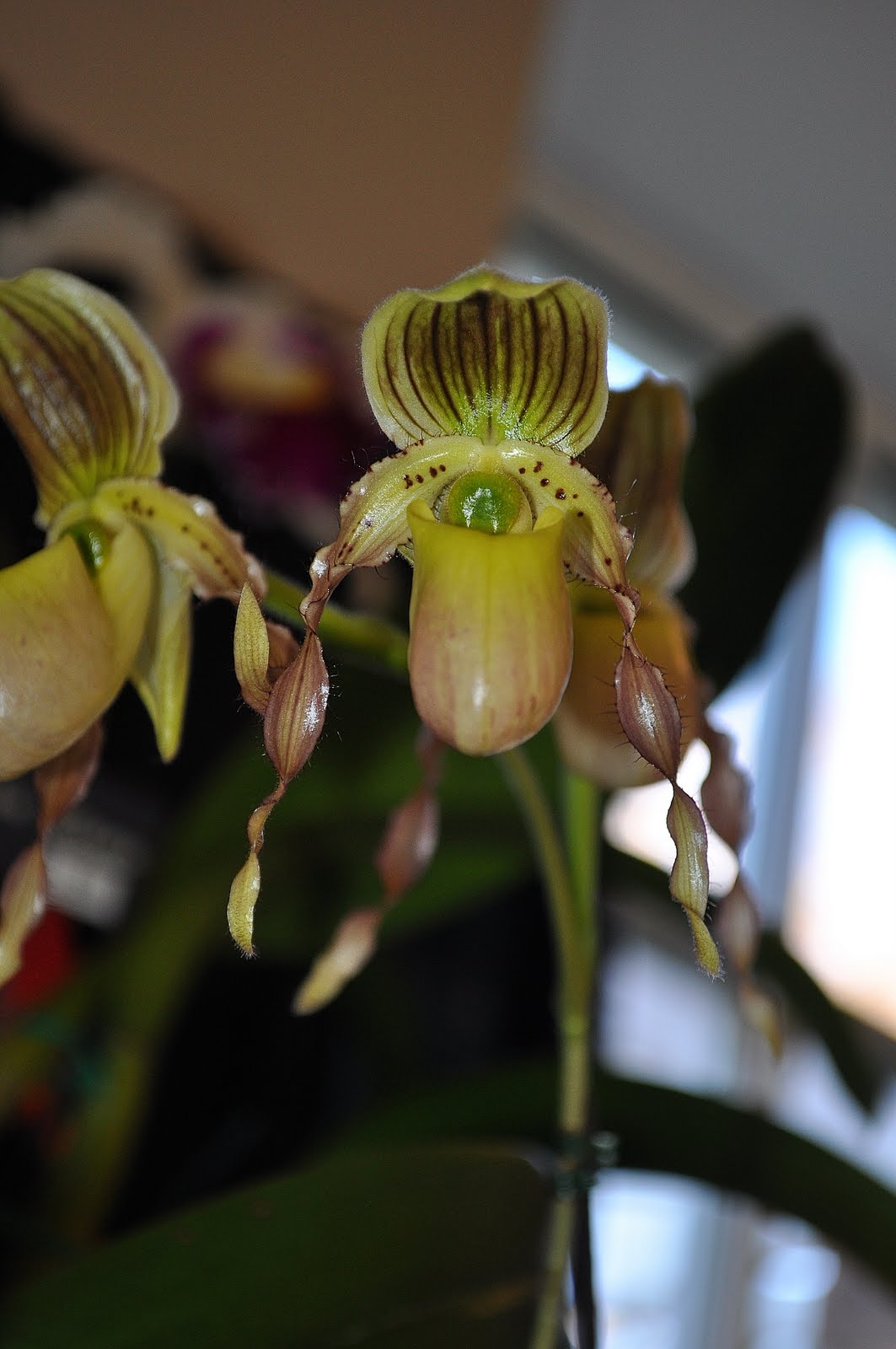


Paphi0pedilum Hsinying Jewel (Mystic Jewel x maudiae), exhibited by Carter & Holmes, received an AM/AOS

Wednesday, February 9, 2011

tracyanum challenge

OK. This is an issue of marital bliss.

My tracyanum did not bloom this year. No surprise since I divided it last Spring because it was becoming too large for indoor culture during Winter. It turns out that my partner, who considers orchids to the extent of "pretty flowers", values tracyanum as one of his favorite orchids!

Oh, how I've failed!!

At dinner tonight, he told me that he's willing to give up space in his garden window so that tracyanum will bloom next year. Truly, no small concession. While acknowledging his generous offer, I reminded him of tracyanum's general size, e.g. leaf length, and of the light requirements, never mind the space necessary to accommodate the flower spike. Nevertheless, he brought out the tape measure to ascertain how large of a plant his garden window can hold--clear demonstration to the seriousness of his offer. There are also concerns (on my part) about one of our cats foraging upon tracyanum's leaves if I should let the plant be housed in that window. She's demonstrated the behavior once before, many years past. But, we can manage her instincts pre-emptively.

It's one thing to push myself to get plants to bloom. After all, this is MY hobby. But, do any of you have your significant others raising the bar?

Are there any compact tracyanums out there? Kobsukh's new hybrid (madidum x tracyanum) will be the next, best alternative.

Tuesday, December 21, 2010

Cym. banaense

Cym. banaense has been in bloom for me this past week. According to my nose, it has a spicy and sweet fragrance. Quite nice! My plant produced two spikes per pseudobulb, but only four flowers per spike. The flowers are do not open fully, much like Cym. mastersii, cochleare and elegans. Also like mastersii, and eburneum, the calli are richly golden and there is a central golden patch surrounded by a pink suffusion in the middle of the lip. Charming.


Saturday, December 18, 2010

Christmas wish for the CSA

It's almost Christmas, just a week away. There's been much discussion between family members via email, phone or around the dinner table about what presents to get each relative. Besides the pre-Christmas drama, and doing my part to be a dutiful citizen by spurring the economy, I use the end of calendar year to think about what improvements I should make in the coming year. Of course, the care of my orchid collection is high on the list. I've gathered random notes, comments and suggestions to help organize my thoughts, but the other day I took advantage of being close to National Agricultural Library to browse through back-issues of the Cymbidium Society of America (CSA) journals (the names have changed over the many decades) which only goes to 1975.

So, here's my Christmas wish for the CSA: Please switch from paper to electronic publishing, and scan all the back-issues for re-publishing.

At issue is that there is a wealth of information and historical commentary that is simply lost for most Cymbidium growers simply because they've come to the hobby either in their middle years, or more directly, in the 21st century. Are these growers destined to recreate the wheel? Or, should they have access to what had been taught over 50 years ago, and in the intervening years, so that they can avoid the mistakes of the past, and use that information to improve?

Frank Fordyce (Orchid Advocate 3(3): 80-84, 1977) addressed these issues, in part, by writing (I'm paraphrasing here...) that "there is a lack of information available in printed form that has been accumulated from previous hybridizing efforts. The [CSA] can provide a tremendous service to its membership now and in the future by the establishment of a long range program to record information that would be important to use in hybridizing. [T]here is an overall complacency with people who are growing or hybridizing Cymbidiums and the fact that they are finding very little progress is being made in their field. Putting the accumulated knowledge gained from years of observation into experimental practice makes a good hybridizer" (and grower, I would add).

Furthermore, I found interviews with now-historical Cymbidium personalities and discussions of grexes and particular clones thereof that are really interesting. For example, I've seen Cym. James Toya 'Geyserland', but I know nothing of the man for which this plant was named. However, there is a story about James Toya in the May-June, 1985 issue. Who knew??

Did you know that there is an article on Cymbidium keeping-quality tests as cut flowers (Jan-Feb, 1985)? This topic is of immediate relevance to me because I have had a stem of (lowio-mastersii x Summer Sands) on the dining table for weeks (photo taken before I cut the stem), still going strong and fragrant.


I recently gave a talk to our judging center on Miniature Cymbidiums. This program necessitated that I go to the library read through the historical literature. But what if the library simply does not have the journals in their stacks? How is one to do research on a topic if the reference articles on that topic no longer exist? Thankfully, the library does contain many back-issues of various orchid journals because the talk would have been so much poorer and uninteresting in the absence of the historical information. But, the collections are incomplete, and there is nothing of the pre-1975 CSA publications. Is that information simply lost forever? If so, what a tragedy.

A common theme that I've often heard is that many orchid societies are suffering from declining memberships. Our own local club has been experiencing this phenomenon, which has spurred us to re-think what service we offer to our members to make it worth their while to join and participate. I think for CSA, a clear service only they can provide is to unearth their history, and re-distribute that wealth of knowledge and experience to the present and future members to promote the Cymbidium hobby.

Saturday, October 23, 2010

Susquehana Orchid Show, Lancaster, PA

The Susquehana Orchid Society held their orchid show this weekend. It was a compact show with 14 individual, society and commercial exhibits, hosted by Stauffer's Garden Center. There was a wonderful diversity of orchid genera on display with well grown plants and flowers.

society exhibit


exhibit #4, society


Fishing Creek Orchids exhibit


exhibit #8


Woodstream Orchids exhibit


Cycnoches Jean E. Monnier (barthiorum x cooperi), exhibited by Orchid Enterprise


Cycnoches barthiorum


Cycnodes Jumbo Micky 'Jumbo Fifi' (Cycnoches Jumbo Dragon x Mormodes badia)


Holcoglossum kimballianum


Dendrobium victoria-reginae, exhibited by Fishing Creek Orchids


Pleurothallis strupifolia


Robequettia cerina, exhibited by Maryland Orchid Society


Cattleya maxima, exhibited by Fishing Creek Orchids


Cattlianthe Porcia 'Cannizaro', FCC/AOS (Cattleya Armstrongiae x Guarianthe bowringiana)


Rlc. Lyn Evans (Rlc. George King x Rlc. Goldenzelle)

Monday, October 11, 2010

2010 NCOS Show/Sale

We've just completed our annual society's Show and Sale, and I'm a little tired after staffing the show for five days and helping take down the sales tent and exhibits this afternoon.

I await the news for today's gross sales, but it appears that Friday-Sunday sales were commensurate with last year's sales, which is actually good news given the state of the economy. This weekend's weather has been nearly perfect, and perhaps would have benefited only with a periodic, light breeze.

This year's venue was in the U.S. National Arboretum's Bonsai House. This is because there is construction beginning in the administration building which houses the space where the show has previously been held. However, the Bonsai House and Pavilion are treasured for their natural lighting. Many of the public explicitly commented to us and the USNA staff that they find this year's exhibit area far superior to the historical, auditorium location. No surprise really, but it helps us lobby the USNA admin to keep us there for future exhibitions.

So, let's start with a sample of the exhibits. Later, we'll move to specific flowers that caught my eye. The island exhibits posed a design challenge for some of our vendors.


The pavilion exhibit space posed another challenge for our vendors and sister orchid societies. It is U-shaped: bending around to the right of the first picture, and then bending once more. Not all maximized use of the vertical space, leaving the floor and/or ceiling areas vacant. I'm hopeful that next year's show will be better now that the exhibitors know the spatial context of their exhibits.


OK, here are some individual orchid pics.
Chen's Ruby 'Golden Tiger', AM/AOS, exhibited by Arbec Orchids


Cym. Kusuda Shining 'Geyserland', HCC/AOS, exhibited by Arbec Orchids. Yes, it's at an odd angle, but the plant was placed high in the display.


Catt. Sophia Martin 'Spots'


Catt. Geri Male 'Fishing Creek', exhibited by Fishing Creek


Renanthera Barney 'Randy', exhibited by Owens Orchids


Rnths. Kathy Burks, exhibited by Owens Orchids


Cyc. William Clark, exhibited by Seagrove Orchids. The buds were closed during AOS judging, but opened up a few days later.


Cyc. cooperi, exhibited by Maryland Orchid Society.


(Cyc. pentadactylon 'Jumbo Best' x Morm. sinuata 'Fireball'): nicely fragrant, almost candy-like, and awarded an AM/AOS at the show.

Sunday, June 13, 2010

Green Home and Garden Tour

This weekend we participated in our town’s Green Home & Garden Tour by opening up our yards to our neighbors. Each participating home highlights one or more features, e.g improved home heating/cooling efficiency, decreased wasted electricity consumption, solar power, tankless water heater, wood pellet stoves, sustainable gardening techniques, water conservation efforts, stormwater runoff management, etc…


Roughly 30 families toured our yard, which kept our dog, Sebastian, busy greeting and socializing while we led overlapping tours. Many visitors are new homeowners out to meet their new neighbors in the community and get ideas of what problems commonly exist in our town's homes, how people solve such problems, and what types of plants work in our climate.


Shortly after moving into our home, we had a home energy audit performed to prioritize the upgrades and alert us to other potential problems. We've improved door and window weatherization, installed energy efficient windows, increased attic insulation (from R-9 to R-49), installed an attic tent to keep heat and conditioned air escaping into the attic, and installed attic ventilation along the eaves and roof ridge.


In the front and back yards, we’ve practiced turf reduction. My partner’s assertion is that turf grass does relatively little to slow stormwater or support wildlife. My reason is that I don’t like to mow the lawn. But, when mowing is necessary, we use a push reel mower rather than a gas or electric mower.


To help manage stormwater, from our house and run-off from our neighbors’ yards, we’ve installed rain barrels, which are especially useful to get us through the late Summer drought, moved the clay around to create berms slowing erosion, installed a sun and water-tolerant terrestrial orchid bed on the sunnier side of the property where stormwater flows, and a bog (partially based on plants which would be found in a Prince George's county, MD Magnolia bog such as cinnamon fern, royal fern, and Pennsylvania sedge) on the shadier side of the property where stormwater flows.


Here's a pic of Bletilla striata, now in bloom in the sunny orchid bed.


In addition to turf reduction, we’ve practiced edible and native landscaping. The edible landscaping comprises a fig tree, paw paw trees, American hazelnut trees, dwarf apple trees, dwarf cherry trees, east coast native Prunus maritima (beach plum), raspberries, blackberries, blueberries (high- and low-bush), cranberries, elderberry bushes, kiwi vines, grape vine, Jerusalem artichoke (sunchoke), rhubarb, strawberry (ground cover), creeping thyme (ground cover), asparagus beds, and multiple herb and vegetable garden beds.


Here's a pic from Saturday morning's harvest...


The native landscaping comprises plants that provide nectar for pollinators, berries for birds and mammals, and butterfly larval host plants, such as buttonbush, Ilex verticillata (winterberry trees), various ferns, milkweeds, native grasses, asters, goldenrods, violets, helianthus (sunflowers), Virginia creeper, Mayapples, Liatris, Callicarpa, Rhus aromatica (sumac bush) and Rhus copalinum (sumac tree).


Okay, so what does the Green Tour have to do with Cymbidiums? Well, my shadeframe is an obvious structure in the back yard, and it did not go unnoticed because Cym. Kusuda Shining 'Bold One' was in full bloom with four spikes of colorful and fragrant flowers.